Asian bush mosquito: the cold-tolerant invasive that quietly transmits West Nile
Aedes japonicus — the Asian bush mosquito — arrived in New Jersey in 1998 and has spent the past two decades spreading across the Northeast and Midwest with very little public attention. It's a daytime biter, it breeds in rock pools and containers, and it has an ability most Aedes species lack: it can efficiently transmit West Nile virus. It's also more cold-tolerant than any other invasive Aedes in North America — established in places the Asian tiger mosquito can't reach.
The short answer
Aedes japonicus is an invasive species from Japan and East Asia, now established across large portions of the northeastern and midwestern United States. It bites during the day, breeds in rock pools, tree holes, and man-made containers, and can persist at higher elevations and more northern latitudes than the Asian tiger mosquito. Unlike other Aedes species, it is an efficient West Nile vector — the only invasive Aedes species with demonstrated competence for WNV transmission under field conditions. It is underappreciated partly because it arrived quietly and spread slowly, and partly because it is not associated with the high-profile tropical diseases that keep Ae. aegypti in the news.
In New York — its US beachhead — Ae. japonicus is now found throughout the state, from Long Island to the Adirondacks. That vertical range (from sea level to mountain elevations) is something no other invasive mosquito species can match in the US.
How it arrived
The first confirmed US collection was in Bergen County, New Jersey, in 1998 — likely arriving in used tires shipped from Asia, the same vector that introduced Ae. albopictus in 1985. Initial surveys found it in Pennsylvania, New York, and Connecticut within two years. By 2005 it had reached the Midwest; by 2015 it was documented in 30+ states.
How to identify it
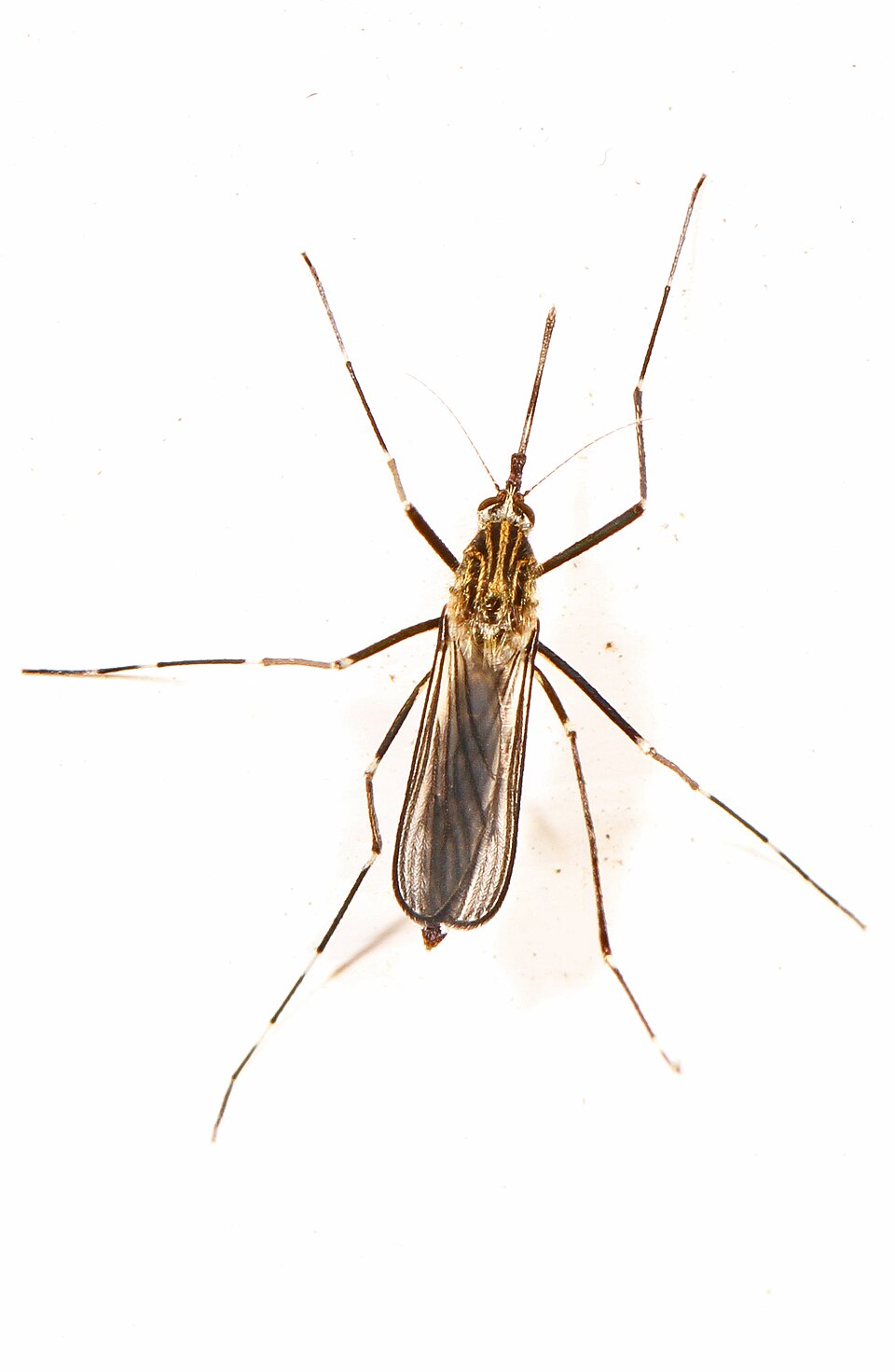
Aedes japonicus is visually striking for a mosquito. The thorax has an ornate pattern of gold and black markings — not a simple stripe like the tiger mosquito, but a more complex lyre-and-curve design with golden scaling. The legs have alternating dark and pale banding. It is medium-sized, slightly larger than Ae. albopictus, and moves somewhat more slowly.
The gold-on-black thorax is the key field mark. Held up to light, the golden markings are distinctive enough that an observant person can often separate it from the tiger mosquito at a glance, even without a hand lens. If you're in the Northeast in a wooded area and you're being bitten during the day by a mosquito with golden markings on its back — that's likely Ae. japonicus.
The West Nile exception
The Aedes genus contains roughly 700 species, and most of them are poor or negligible West Nile vectors. The virus circulates primarily in Culex species. Aedes japonicus is a significant exception: vector competence studies have shown it can become infected with WNV, replicate the virus, and transmit it during a blood meal — something most Aedes species do inefficiently or not at all.
Field evidence for WNV transmission by Ae. japonicus has been documented in several northeastern states. It is not the dominant vector — that role belongs to Culex pipiens in northern cities — but in highland areas and rural settings where Culex populations are lower and Ae. japonicus is abundant, it may be a meaningful contributor to transmission risk.
It is also a competent vector for La Crosse encephalitis (shared with Ae. albopictus) and has shown laboratory vector competence for Japanese encephalitis and West Nile under experimental conditions.
The high-elevation risk factor. Ae. japonicus can establish in mountain terrain at elevations where Culex pipiens is sparse or absent. Hikers and campers in wooded highland areas of the Northeast and Mid-Atlantic who assume mosquito season is over at elevation or that mountain mosquitoes don't carry disease should know that this species is present and can transmit West Nile.
Breeding habitat
Aedes japonicus is a rock pool specialist in its native Japan — it evolved in upland streams with rocky margins where water pools in stone depressions. In North America, it has adapted broadly to container habitats: tree holes, used tires, cemetery flower vases, catch basins with rocks or debris, and artificial containers. It has a notable preference for shaded, cool water compared to Ae. albopictus, which competes with it for similar container habitats.
It also breeds more successfully than most container-breeding species in larger water bodies — barrel-sized containers, water troughs, and retention features with some shading are productive sites. Where water sits in the shade of mature trees in rocky terrain, this is often the dominant species.
Protection
Standard daytime repellent use applies — DEET, Picaridin, or IR3535 during outdoor activity in wooded and shaded areas. Container source elimination overlaps significantly with measures against the Asian tiger mosquito, so the same weekly property check protocol applies: empty, scrub, or treat any container that holds water in a shaded location.
In areas where Ae. japonicus is the dominant species, the conventional focus on dusk protection (for Culex) should be supplemented with daytime repellent use — particularly for children playing in wooded or shaded yards.
Sources
- Kaufman, M. G., et al. (2012). Aedes japonicus japonicus (Diptera: Culicidae): a cold-hardy invasive mosquito species in North America. Journal of Medical Entomology, 49(3), 652–660.
- Fonseca, D. M., et al. (2001). Emerging vectors in the Culex pipiens complex. Science, 289(5487), 2267–2269.
- Sardelis, M. R., et al. (2002). Vector competence of Aedes japonicus for West Nile encephalitis virus. Journal of the American Mosquito Control Association, 18(2), 87–90.
- Peyton, E. L., et al. (1999). Aedes (Finlaya) japonicus, a new introduction into the United States. Journal of the American Mosquito Control Association, 15(2), 238–241.
Check today's mosquito activity for your area on the home page, or compare with the Asian tiger mosquito — the other invasive daytime biter spreading across the US. State guide: New York.