Yellow fever mosquito: the Gulf Coast's dengue and Zika vector
Aedes aegypti — the yellow fever mosquito — is smaller, harder to notice, and more medically dangerous than almost anything else biting you in the continental United States. It's a daytime biter that specializes in humans, and it carries dengue, Zika, and chikungunya. If you live in Florida, coastal Texas, or parts of Southern California, this is the species your health department worries about most.
The short answer
Aedes aegypti is established year-round in southern Florida, coastal Texas, and parts of Southern California. It bites during the day — peak activity is mid-morning and late afternoon — and it has an unusually strong preference for human blood over animals. It breeds in tiny containers of clean water inside and around homes. The diseases it carries (dengue, Zika, chikungunya, yellow fever) are not currently endemic to the continental US, but local transmission clusters happen, and the species is considered the reason they can.
Where it lives and where it doesn't
Aedes aegypti is a tropical and subtropical species. It cannot survive cold winters — eggs and adults both die at sustained freezing temperatures. Its US range is limited to the southern tier: year-round populations in peninsular Florida and the Texas Gulf Coast, with seasonal presence in parts of Arizona, New Mexico, and Southern California. In California, it has established in 20+ counties of the greater Los Angeles and Central Valley areas — an expansion that was not detected until 2013 and has continued since.
One factor driving its California expansion: Ae. aegypti can breed in drip irrigation emitters, potted plant saucers, and the ornamental features common in Southern California yards. The arid climate that kills other mosquito species actually doesn't stop this species — it just needs small pockets of artificial water.
Notably, Ae. aegypti is in direct competition with the Asian tiger mosquito (Ae. albopictus) wherever their ranges overlap. Ae. albopictus tends to outcompete and displace Ae. aegypti in more temperate conditions — one of the reasons Ae. aegypti has actually retreated from some of its mid-20th century range in the Southeast.
How to identify it
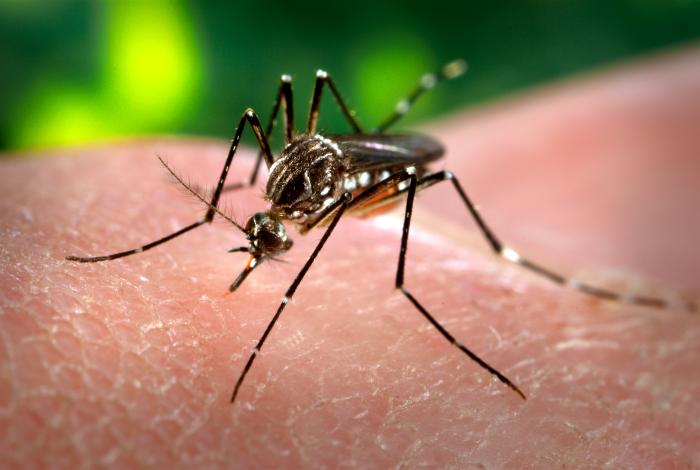
Aedes aegypti is a small, dark mosquito with distinctive white markings. The diagnostic field mark is a lyre-shaped white pattern on the thorax — it looks like a white outline of a musical lyre or a "U" with two curved lines. The legs also have white bands, and the abdomen has pale scaling on each segment. It is noticeably smaller than a typical Culex mosquito and moves fast.
Behaviorally, it bites from below — ankles and lower legs are common targets. It is stealthy: unlike some mosquitoes that buzz audibly before landing, Ae. aegypti often lands and begins feeding before you notice it. It is also persistent; swatting it away repeatedly doesn't reliably deter it from returning.
It can be confused with Ae. albopictus (the Asian tiger mosquito), which also has white markings and bites during the day. The key difference is the thorax marking: Ae. albopictus has a single bright white stripe down the center of the thorax; Ae. aegypti has the lyre pattern — two curved lines, not one straight stripe.
What diseases does it carry?
Aedes aegypti is the primary global vector for four significant viral diseases: dengue fever, Zika virus, chikungunya, and yellow fever. In the continental US, none of these are currently endemic — but local transmission clusters have occurred, particularly in Florida and Texas, where the mosquito is established and imported cases from travelers regularly arrive.
Dengue is the most practically relevant. Florida has documented locally acquired dengue cases in Miami-Dade, Broward, and Palm Beach counties in multiple recent years. Texas has documented local transmission near the Mexican border. These are not major outbreaks — they are small clusters, caught early — but they confirm that the transmission chain exists and that Ae. aegypti is the link.
Zika received the most public attention during the 2015–2016 pandemic. Florida documented the first locally transmitted Zika cases in the continental US in 2016, in Miami's Wynwood neighborhood. Ae. aegypti was the vector. Cases dropped sharply after mosquito control operations and waning imported cases, but the species — and therefore the potential pathway — remains.
Dengue is not just a travel disease anymore. If you live in South Florida or coastal Texas and develop sudden high fever, severe headache, pain behind the eyes, or a characteristic rash 4–10 days after being outside, mention potential dengue exposure to your doctor. Local transmission is rare but documented. Early clinical recognition matters because dengue can become severe.
Where it breeds
Aedes aegypti is a container breeder — it evolved breeding in tree holes and rock cavities in tropical forests, and it has adapted those habits to domestic environments with remarkable efficiency. It seeks small, clean, still water. Common breeding sites in and around homes include:
Plant saucers and pot drip trays, especially those kept in shade. Birdbaths that aren't changed frequently. Roof gutters with debris accumulation. Bottle caps, discarded cups, and food containers with trapped rainwater. Ornamental containers, vases with water, and cut-flower holders. Tire swings. The trays beneath air conditioning units.
It also breeds indoors — in flower vases, unused toilets in vacation homes, and storage containers — to a degree that most other US mosquito species do not. This indoor breeding behavior is one of the reasons it is so difficult to eliminate through standard outdoor-focused mosquito control.
Unlike most mosquitoes, Ae. aegypti actually prefers clean water. It is not attracted to the stagnant, organic-rich water that Culex species prefer. If you're finding it breeding near your home, it's not the ditch water or the drainage — it's a small, clean container you haven't checked.
What changes about protection
Because Ae. aegypti bites during the day, the standard advice — use repellent at dusk, stay inside at dawn — does not apply. Apply DEET, Picaridin, or IR3535 before going outside during daylight hours in areas where this species is established. This is especially important during the warm months in South Florida and coastal Texas.
Consider eliminating every standing water container on your property every 3–4 days — the minimum time for larvae to develop into adult mosquitoes. Even containers that are not obviously holding water may be sufficient. In areas of active dengue transmission, health departments often recommend weekly inspections.
Window and door screens are more relevant for Ae. aegypti than for other species because of its indoor breeding and indoor biting habits. Air conditioning — which keeps windows closed — provides meaningful protection in areas where the species is active.
Sources
- Centers for Disease Control and Prevention. Mosquitoes in the United States — Aedes aegypti.
- Kraemer, M. U. G., et al. (2015). The global distribution of the arbovirus vectors Aedes aegypti and Ae. albopictus. eLife, 4, e08347.
- Radke, E. G., et al. (2012). Dengue outbreak in Key West, Florida, USA, 2009. Emerging Infectious Diseases, 18(1), 135–137.
- Florida Department of Health. Locally acquired dengue case reports, 2022–2025.
- California Department of Public Health. Invasive Aedes mosquito surveillance program.
Check today's mosquito activity for your area on the home page, or read about the Asian tiger mosquito — another daytime biter established across the Eastern US. State-specific guides: Florida · Texas · California.