Southern house mosquito: the dusk biter that carries West Nile
Culex quinquefasciatus — the southern house mosquito — is what most people in the South and Southwest picture when they think of a mosquito. It's the one that ruins summer evenings on the patio, buzzes near your ear while you're trying to sleep, and in bad years appears in numbers that feel genuinely biblical. It's also the primary West Nile virus vector throughout the southern United States.
The short answer
Cx. quinquefasciatus is a dusk-to-dawn biter — most active in the two hours after sunset and before sunrise. It breeds in stagnant, organically enriched water: storm drains, ditches, neglected backyard containers. It's a competent West Nile vector and a major transmitter of Saint Louis encephalitis. It's also the species that transmits avian malaria, contributing to the near-extinction of native Hawaiian birds. If you're getting bitten in the evening in Florida, Texas, Georgia, or California, this is almost certainly the species doing it.
Unlike its northern counterpart Cx. pipiens, Cx. quinquefasciatus feeds readily on both birds and humans — which is precisely what makes it an effective bridge vector for West Nile. It picks up the virus from birds (the reservoir host) and delivers it to humans in the same feeding cycle.
Range and habitat
Culex quinquefasciatus is a warm-climate species established throughout the southern United States: Florida, Texas, Georgia, the Gulf Coast states, and California. It is the dominant Culex species in most of the South, replaced by its close relative Cx. pipiens roughly north of the 36th parallel (through the Mid-Atlantic, Ohio Valley, and into the Midwest). In the transition zone — the Carolinas, Virginia, Tennessee, Kansas — the two species interbreed, producing fertile hybrids with intermediate characteristics.
In California, Cx. quinquefasciatus is the dominant species in the Central Valley and Southern California — the same areas that represent the country's most active West Nile corridor. Sacramento County, Fresno County, and Los Angeles County have all seen significant West Nile transmission in recent years, driven primarily by this species.
How to identify it
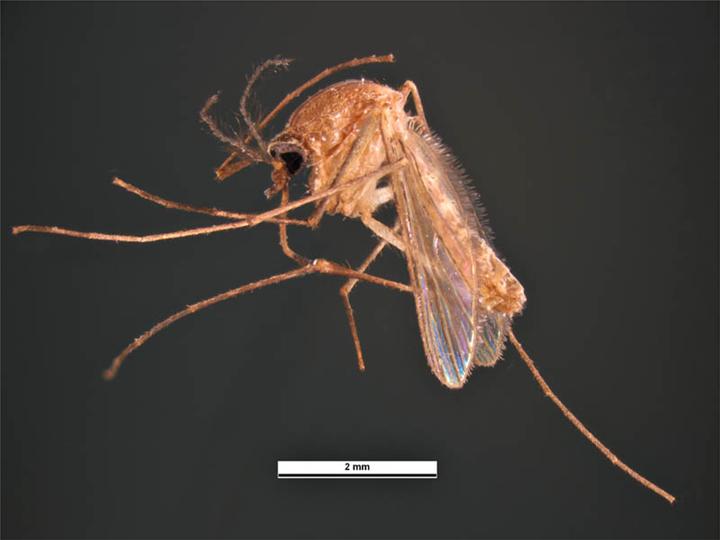
Culex quinquefasciatus is a medium-sized, brownish mosquito — unremarkable in appearance compared to the more visually distinctive Aedes species. The diagnostic feature is the pale banding at the base of each abdominal segment, visible on closer inspection as whitish-yellow horizontal stripes on a brown background. It lacks the bold black-and-white striping of Ae. albopictus and the lyre marking of Ae. aegypti. If you catch a nondescript brownish mosquito biting you after dark in the South, it is almost certainly this species or a very close relative.
It is also the species most commonly found resting inside houses during the day — on walls, under furniture, in closets and dark corners. The female feeds at night and rests in sheltered, humid locations during daylight hours.
West Nile virus and the bridge vector problem
West Nile virus circulates primarily in birds. Culex quinquefasciatus maintains the transmission cycle by feeding on infected birds, amplifying the virus through repeated blood meals in the bird population, and then — critically — also feeding on humans and other mammals. This cross-species feeding pattern is what makes it a "bridge vector": the biological link that moves a bird disease into human populations.
Most people infected with West Nile virus (roughly 80%) experience no symptoms. Of the 20% who do develop illness, most have a fever, headache, and body aches that resolve within a week. About 1 in 150 infections progresses to neuroinvasive disease — encephalitis or meningitis — which can be severe or fatal, particularly in older adults and immunocompromised individuals. There is no vaccine or specific treatment.
West Nile activity is seasonal — transmission peaks July through September across most of the US, when Cx. quinquefasciatus populations are at their highest and bird migration brings infected reservoir hosts into close contact with dense suburban mosquito populations.
Dead birds and West Nile. If you find a dead crow, jay, or raptor, report it to your local health department or state wildlife agency — many states actively track WNV-positive bird die-offs as an early warning indicator. Don't handle dead birds with bare hands. This is standard surveillance protocol, not cause for alarm.
Where it breeds
Culex quinquefasciatus strongly prefers stagnant, organically enriched water — the kind that has had time to accumulate decomposing organic matter and develop a microbial bloom. Storm drains and catch basins are among the most productive breeding sites in urban areas. Roadside ditches, flooded low-lying areas, and neglected ornamental ponds are also highly productive. In residential settings: gutters clogged with leaf debris, neglected birdbaths, and any standing water that's been sitting undisturbed for more than a week.
This preference for "dirty" water distinguishes it from Ae. aegypti (which prefers clean water in small containers) and is part of why storm drain treatment with Bti (Bacillus thuringiensis israelensis) is a standard tool for municipal mosquito control agencies targeting this species.
Protection strategy
Focus protection on the dusk window. Applying repellent before going outside in the evening — DEET 20–30%, Picaridin, or IR3535 — is the primary personal intervention. Long sleeves and pants at dusk reduce exposure further. If you're eating outside in peak season, finishing before or moving inside by 30 minutes after sunset meaningfully reduces your exposure window.
At the property level, eliminate or treat standing water that has had time to become stagnant. Storm drain grates on your property can be treated with Bti dunks. Repair gutters and improve drainage in areas that pond after rain. Window and door screens in good repair make a significant difference — Cx. quinquefasciatus enters homes readily when doors and windows are left open at night.
Sources
- Reisen, W. K. (2010). Landscape epidemiology of vector-borne diseases. Annual Review of Entomology, 55, 461–483.
- Kilpatrick, A. M., et al. (2005). West Nile virus risk assessment and the bridge vector paradigm. Emerging Infectious Diseases, 11(3), 425–429.
- Centers for Disease Control and Prevention. West Nile virus — surveillance and data.
- Farajollahi, A., et al. (2011). "Bird biting" mosquitoes and human disease: a review of the role of Culex pipiens complex mosquitoes in epidemiology. Infection, Genetics and Evolution, 11(7), 1577–1585.
Check today's mosquito activity for your area on the home page, or see the northern counterpart: common house mosquito (Cx. pipiens). State guides: Florida · Texas · Georgia · California.